

Women representation in film has been a relevant topic for decades, but it is especially in the last 4-5 years since the start of the MeToo movement that it became even more influential in the industry.
Probably the most popular parameter to monitor women’s representation in movies, the Bechdel Test was actually first created in the 80s and appeared in Alison Bechdel’s comic strip Dykes to Watch Out For (published in 1985). Bechdel shares the first idea for the test with friend Liz Wallace, hence it should be called the Bechdel-Wallace Test. The rules are simple and straightforward: 1. There have to be at least 2 named female characters; 2. They have to talk to each other; 3. The conversation needs to be about something other than a man. The character in the comic strip says that she only goes to a movie if it passes the test, and the last movie that she’s been able to watch was Alien (Ridley Scott, 1979).
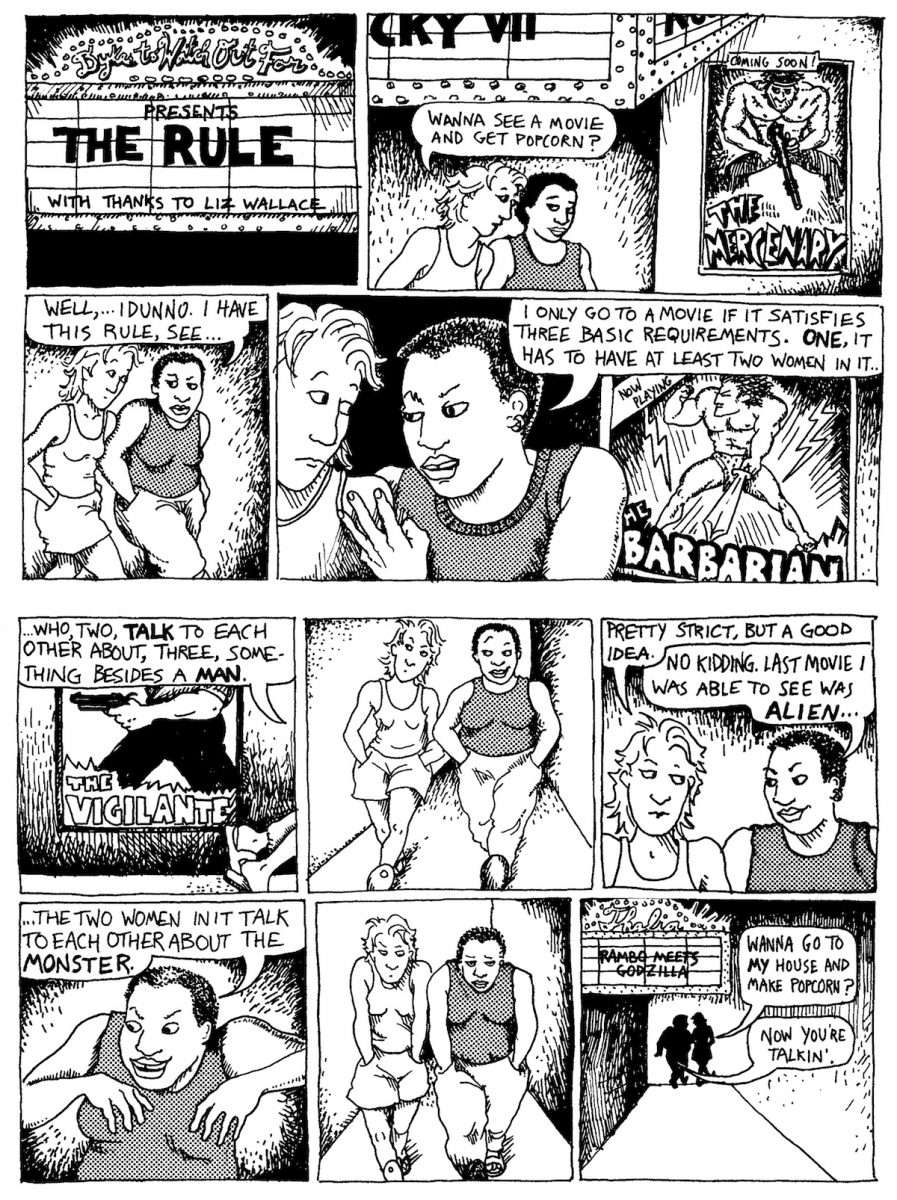
The test gained popularity through the 2000s when the discourse around women in film started to gain more and more attention. The inspiration came from the 1929 essay by Virginia Woolf A Room of One’s Own where she observes how women’s portrayal in fiction has been always limited to their relations to men. This 3-rule test is used as a way to track the active presence of women in films and fiction and target the issue of gender inequality. A lot of media studies indicate that those who pass the test have better chances at becoming financial successes. Also, different studies brought to light not only the fact that the proportion is generally 2 male characters for each female, but also that women are twice likely to being involved in sexual content. In 2017 the top three grossing films – Star Wars VIII (Ryan Johnson), Beauty and the Beast (Bill Condon) and Wonder Woman (Patty Jenkins) – all passed the test.
The website bechdeltest.com is a user-generated website where everyone can comment about why and how they agree or disagree with a particular movie passing the test or not. The catalogue of titles is very rich and what stands out is the sometimes unexpected red or green stamp that appears in front of a specific title.
This is because the test touches on representation in a quantitative more than a qualitative way and cannot state how feminist a work of fiction is. Often the Bechdel Test is wrongly assumed to measure diversity in terms of feminism but that’s not the case: you would need a much more in-depth cultural analysis for that. A 3-rule test leaves little space for a critical discourse, and the same goes for other inclusivity and diversity issues. For this reason there are quite a few feminist films that fail the test because their dynamics don’t necessarily pass through all of these instances, whereas many extremely sexist films do get the green stamp but nothing is known about the actual content of those conversations, or the tone, or the kind of interactions they have.
Alison Bechdel didn’t intend to make this about the quality of a film, in fact she says that some of her favorite ones don’t pass the test. The point is not about how feminist or good the movies are in itself, its aim is to show a systemic problem that makes narrative and other media mainly focused on a male-centered vision. What Virginia Woolf also brought to attention in her essay is that women’s relations are generally represented as mother-daughter or enemies, but rarely as friends. A Room of One’s Own is now almost 100 years old but the general view hasn’t changed.
Many tests were created in recent years to mirror the Bechdel-Wallace one. For example a “reverse test” that monitors the portrayal of men in recent movies with rules as: 1. One named male character; 2. Who is moral, competent and masculine; 3. No gratuitous belittling or domination of male characters. The creator argues that since MeToo many gratuitous scenes were added where women prevail on men, but in his opinion they don’t always translate to a better representation for women. Other tests that were created in response to Bechdel’s touch issues like sexual orientation, race or ethnicity. A “new improved version” of the original was issued by fivethirtyeight.com called “The New Bechdel Test” with questions like: 1. Was the supporting cast at least 50% women? 2. Did a woman write or direct the film? 3. Did a female lead end up dead? 4. Is there a black woman in the film? https://projects.fivethirtyeight.com/next-bechdel/

The major controversy about the Bechdel Test is the improper use that some media analysts have made out of it, regarding it as a way to measure feminist representation in film. First of all, feminism is not a quantitative matter or, at least, not only. Feminist or gender studies analysis is much more articulate and complicated than that. Another issue that the users comments brought to light is the fact that the definition of “male character” is way too broad: for example, is a conversation about children counted as valid if the child is a boy? Or in Alien, how do we define the monster’s gender?
The test being very simple and quite vague makes it difficult to understand its limits: it doesn’t define conversations (could include men as a topic but mixed with other things as well) and also, how do you rate a movie which setting makes it impossible to include women (e.g. The Name of the Rose is set in a medieval monastery, 1917 takes place in the trenches of WWI)?
Also, the misuse of the Bechdel Test hurts the purpose of feminism: why is a conversation between women about men seen as something negative and less powerful than let’s say, make up and cooking? It’s difficult to define and judge a conversation without analyzing the actual content and how it was carried out. The danger could be that conversations between men and women that do not regard romantic/sexual topics could be discarded, whereas they could be actually very important in validating a balanced representation between sexes.
The purpose of reverse tests is to point out that movies that include certain conversations/situations only to suit the canon and be perceived as more appealing to ensure the favors of the public and critics, are not more feminist. Usually this happens in blockbusters with a very elevated budget that don’t want to take risks and raise controversy. What should matter most is the integral active part that female characters play in a movie: would it come to the same ending if this character is cut out of it?
Media is shaped by culture and shapes culture, not just as a reflection, for this reason it’s a very big responsibility. In recent years the test has been widely used and addressed by critics gaining even more popularity in the 2010s. For example it’s been used in Sweden as an official rating system both by national tv and by the Swedish Film Institute. In 2014 Eurimages incorporated this test into its submission mechanism and since 2018 also the screenwriting software Final Draft introduced the possibility to analyze the scripts in terms of gender representation. This contributed to the test’s validation but at the same time it raised the attention on the controversies regarding it. The main dispute about it is that it has been elevated way beyond its original intention. Nowadays “passing the Bechdel Test” has become synonymous with “feminist portrayal”. It was never intended to be a feminist indicator but this misconception has lead some creators to “game the system” by adding just enough women characters and dialogue only in order to pass the test. And the main explanation to why many films don’t reflect a certain vision is the general lack of gender diversity among industry professionals, or the so called “celluloid ceiling”.
Here are some examples of recent films directly taken from bechdeltest.com:
- Don’t Look Up (Adam McKay, 2021) passed but many people commented on it not being feminist
- Licorice Pizza (Paul Thomas Anderson, 2021) passed but one of the 2 women wasn’t clearly named
- Nightmare Alley (Guillermo del Toro, 2021) failed to pass but someone argued that technically 2 named women did speak to each other, even if only 1 line
- Tick,Tick… Boom! (Lin-Manuel Miranda, 2021) passed but the “conversation” is either a song or it’s indirectly connected to the main male character
- One Night in Miami (Regina King, 2020) failed to pass because we don’t really have female characters with a long enough screen time to have an actual conversation
Did You Know?
- Raindance Film Festival is considered one of the top fifteen film festivals in the world?
- Raindance Film School London offers HND, BA and MA in Filmmaking and Screenwriting?
- Let Raindance guide you on your filmmaking pathway. call +44 (0) 207 930 3412 or email filmschool@raindance.ac.uk
- Raindance members support indie film, and enjoy a range of benefits

