

Software as a Service (SaaS) is a cloud-based model for delivering software and applications to B2B film production software businesses over the Internet.
Building an accurate SaaS financial model can help you understand your revenue potential. It also gives you a good look at your expenses and other critical metrics important to investors.
A robust financial model can significantly boost your B2B film production software business’s chances of scaling up operations. If you want to know how to achieve that, read to the end.
How to Build a SaaS Financial Model for Your B2B Film Production Software Business
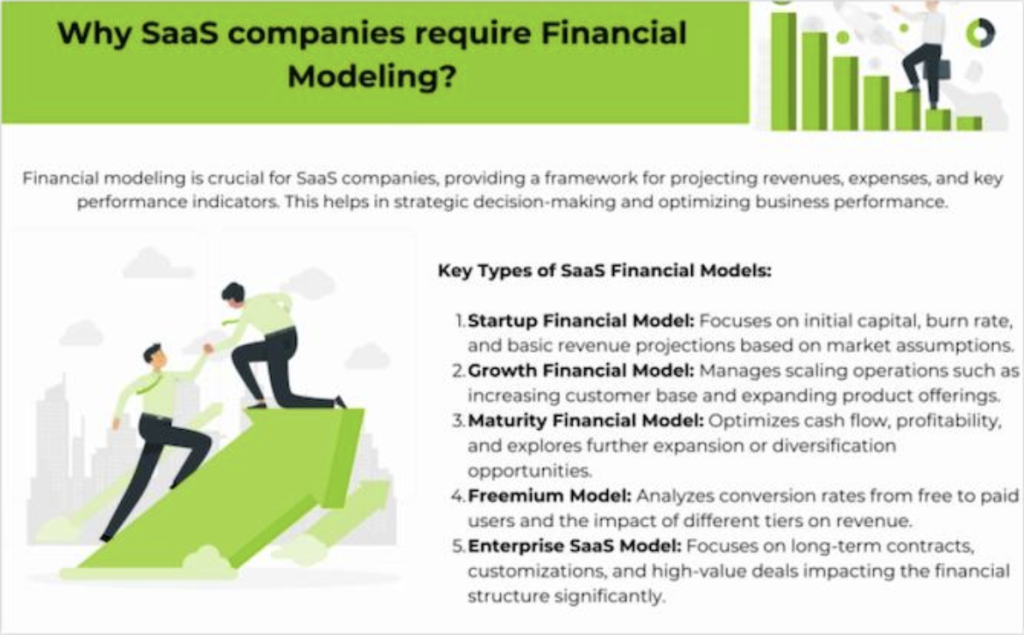
Image via Oak Business Consultant
Here are the key steps to design a successful SaaS financial model for Your B2B film production software.
1. Define Key SaaS Metrics
The first step involves defining your metrics. These include Monthly Recurring Revenue (MRR), Customer Churn Rates (CCR), Customer Lifetime Value (CLV), and Customer Acquisition Cost (CAC). All these offer insight into your business’s health.
For example, MRR can predict your income while LTV and CAC show you customer profitability. You can use CCR to track the rate of customer engagements.
2. Build Revenue Assumptions
Revenue assumptions are the expected estimates of the money you make selling products and services in a given period.
According to the Younium revenue recognition guide, a B2B business’s realistic forecast will give you a good financial outlook for your B2B film production software business. You need to consider all revenue streamers, such as subscription plans and setup fees, depending on what you sell.
3. Forecast Expenses and Cost Structure
The next step in designing a SaaS financial model is understanding your expenses. This helps you manage healthy profit margins as you simultaneously achieve scalability.
The best way around this is to categorize your expenses into different tiers. This could be broken into Research and Development, Sales and Marketing, or Customer Success. Each category will have its dynamics.
4. Model Customer Acquisition Costs
Customer Acquisition Cost is critical for revealing how much you’re spending to win over new customers. SaaS companies must understand CAC because it directly impacts profitability.
Some of the efforts involved include sales expenses used to get new customers, and the cost of advertising.
You can model CAC effectively by breaking down the costs related to customer acquisition. Furthermore, segmenting your customers based on acquisition channels will give you a good idea of what works best.
5. Calculate Customer Lifetime Value
Customer Lifetime Value measures the total revenue you expect to get from a single customer over their entire relationship with your B2B film production software. It is a powerful metric for SaaS B2B businesses as it informs strategic decisions like pricing models and marketing budgets.
With this, you can maximize customer profitability without straining your budget. This is an essential financial model that guarantees you growth and success.
6. Model Customer Churn and Retention
The churn rate is the percentage of customers who leave your B2B film production software business over a specific period. Retention, on the other hand, measures how many of these customers stay with you over that same period.
You can combine these two metrics to identify the direction your B2B film production software business is going. High churn rates should alarm you as that indicates customer dissatisfaction or an overpriced model.
High retention, on the other hand, is good news, and you can focus on improving what keeps people coming back.
A low customer churn rate and higher retention can help an online business to generate good revenue for your B2B film production software business.
7. Plan for Cash Flow Management
Without cash flow, your SaaS film production software business is dead in the water. A strong cash flow management ensures you have sufficient liquidity to cover operational costs and emergencies.
You need to map out all your cash inflows and adjust things like payment terms, billing cycles, and renewal rates. At the same time, keep an eye on your cash outlaws like salaries, server costs, and marketing expenses.
8. Build Scenarios and Sensitivity Analysis
Scenario building helps you understand how different variables affect your B2B SaaS film production software business. It involves building a best-case, worst-case, and base-case scenario so you can prepare for any of the three outcomes.
You can do this by first identifying key assumptions that drive your SaaS financial model. Then you need to adjust these assumptions to see how they impact your projections.
Sensitivity analysis lets you figure out what works and what doesn’t so you can know what to prioritize.
Conclusion
That’s how you build a SaaS financial model for your B2B film production software business. It’s a strategic tool that prepares your B2B film production software business for any eventuality, and it goes beyond crunching numbers. Therefore, follow the steps outlined above to set a clear growth path for your B2B film production software business.

Gaurav Sharma is the founder and CEO of Attrock, a results-driven digital marketing company. Grew an agency from 5-figure to 7-figure revenue in just two years | 10X leads | 2.8X conversions | 300K organic monthly traffic. He also contributes to top publications like HuffPost, Adweek, Business 2 Community, TechCrunch, and more.
